
Office Clearance Brent Cross — Health & Safety Policy Overview
This statement outlines the health and safety policy that applies to office clearance and rubbish removal services operating in and around the service area. The policy sets out commitments to protect staff, contractors, clients and the public during any commercial clearance or domestic office waste project. It applies to routine small-scale office rubbish removal as well as larger scale Brent Cross office clearance tasks where multiple trades and transport resources are deployed.Our purpose is to identify hazards, evaluate risks and implement control measures to reduce the likelihood of harm from manual handling, vehicle movements, waste handling and environmental contamination. The policy emphasises training, competency and the provision of adequate protective equipment so that every team member understands their role in safe office rubbish clearance operations.
Responsibilities and Management Commitment
Senior management take overall responsibility for health and safety. Line managers are tasked with ensuring that site-specific risk assessments are carried out before any job. Employees and subcontractors must follow instructions, report hazards and participate in safety briefings. The policy expects that all personnel engaged in rubbish removal Brent Cross activities will be suitably trained and keep records of competency, licences and certifications where applicable.The company will carry out documented risk assessments for each clearance, considering factors such as building access, stairways, lift capacity, storage zones and the nature of materials to be moved. Risk assessments will identify required control measures like mechanical lifting aids, exclusion zones, correct signage and supervision during sensitive operations such as data-bearing equipment removal or file shredding prior to disposal.
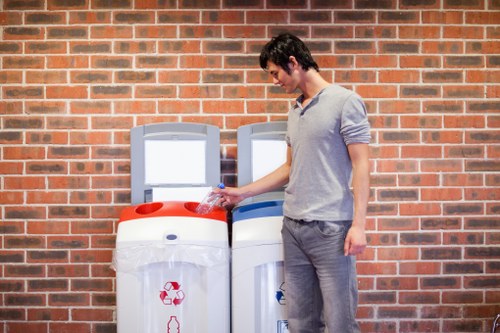
Safe systems of work include segregation of waste streams to minimise contamination and to comply with environmental responsibilities. All staff involved in waste segregation will be trained in the correct handling of paper, cardboard, plastics, inert materials and any items potentially classified as hazardous. Records of waste transfer and manifests will be kept for traceability in accordance with industry good practice.

Training, Personal Protective Equipment and Competence
Employees and contracted crews must receive role-specific training, including manual handling, use of trolleys, sack barrows and tail-lifts, plus vehicle securement methods. Appropriate PPE such as gloves, hi-vis clothing, safety footwear and eye protection will be provided and maintained. Ongoing refresher sessions and toolbox talks reinforce safe behaviours for all office clearance services.Vehicle safety and transport controls are integral to our rubbish collection and removal processes. Vehicles used for site clearance are subject to daily checks, secure load procedures and driver competence assessments. Drivers and loaders must maintain clear communication when loading to avoid pinch points and ensure safe entry and exit from vehicles. Vehicle risk controls extend to parking, reversing, and pedestrian segregation on client sites.
Operational controls include documented method statements for complex jobs, coordination with client site managers, and use of protective coverings to prevent damage to floors and fixtures during commercial clearance projects. A basic checklist is used on every job to confirm protective measures are in place before work starts:
- Site access and egress confirmed
- Protection of sensitive surfaces and furniture
- Segregation and labelling of hazardous items
- Emergency contact and evacuation routes identified
Emergency procedures and incident reporting are essential. All incidents, near misses and unsafe conditions must be reported promptly through the company incident system. Investigations will identify root causes and corrective actions to prevent recurrence. First aid provision, nominated trained first aiders and clear routes for emergency services access form part of preparedness for every project.
Site safety during a clearance includes controlling work zones, exclusion of non-essential personnel and use of barriers where needed. If asbestos-containing materials or other hazardous suspect materials are encountered, work will stop and competent advice obtained. We maintain a conservative approach: when in doubt, treat unknown materials as hazardous until proven otherwise via appropriate testing.
Manual handling forms a significant proportion of the risk in office clearances. Training focuses on safe lifting techniques, team lifts for awkward items and use of mechanical aids for bulky or heavy loads. Supervisors monitor practices and correct unsafe lifting behaviour. This reduces musculoskeletal injuries and supports sustainable workforce health.
 Staff welfare and communication are central to a positive safety culture. Briefings before each job ensure everyone understands the scope, hazards and controls. Welfare arrangements, rest breaks and access to hydration are provided. Clear policy on fatigue management and fitness for work helps the team deliver secure office clearance services.
 Monitoring, audit and continual improvement drive performance. Routine audits, site inspections and performance reviews measure compliance with the health and safety policy. Findings result in action plans, training improvements and updates to procedures. The policy is reviewed annually or following significant incidents to reflect changes in operations or industry best practice.
Environmental responsibility is embedded in our approach to clearance. Wherever practicable, materials are recycled or redirected for re-use. Hazardous or electronic waste is handled by authorised facilities to avoid pollution and ensure secure destruction of confidential materials prior to disposal. Records demonstrate chain-of-custody for sensitive waste streams.
Commitment: The company is committed to maintaining safe, lawful, and responsible Brent Cross office clearance and rubbish removal operations. Management and staff together will work to implement this policy, drive continual improvement, and ensure that every project is carried out with the highest regard for health, safety and environmental stewardship.
